 Largest Ceiling
  CALL :
  About us
 FAQs
FAQs Gallery
 Contact


 Ceiling Planks
 2×2 PVC Ceiling Tiles
 Styrofoam Ceiling Tiles
 Wall Mural
 3D Wall Panels
 Crown Moldings
 Faux Wood Beams
 Other Products
Do decorative ceiling panels help with room acoustics?
Here is the honest answer to the ceiling panels acoustics question before you read another word: decorative ceiling panels can help a room sound a little better, but most of them are not acoustic treatment, and swapping your ceiling alone will not turn a echoey room into a recording studio. If your main goal is looks, a decorative ceiling tile collection is a great upgrade. If your main goal is quiet, the ceiling is only one piece of a much bigger picture.
So where does the truth sit? Below we break down what actually controls how a room sounds, how much a decorative panel realistically contributes, and the layered approach that genuinely calms a loud, echoey space. No hype, just how sound behaves in a room.
In this article
The short answer
People usually mean one of two different things when they ask about ceiling panels and sound. The first is echo inside a room, the ring and harshness you hear in a bare space. The second is sound passing between rooms or floors, like footsteps overhead or a TV through the ceiling. These are different problems with different fixes.
Decorative panels made from materials like PVC, tin-look metal, or dense foam are chosen mostly for appearance and easy installation. They can take a small edge off echo, especially compared to a hard, flat drywall ceiling, but they are not designed to block sound between floors. That job belongs to mass, insulation, and how the structure is built. Setting that expectation up front saves a lot of disappointment.
The honest take
Decorative ceiling panels are a styling choice first. They can slightly soften a room’s echo, but they are not soundproofing and they are not a substitute for real acoustic treatment. Buy them for the look, and treat any acoustic benefit as a small bonus.

What actually controls how a room sounds
Room acoustics come down to what happens to sound waves after they leave a source. They either get absorbed, reflected, or pass through a surface. Understanding those three behaviors explains why some rooms feel calm and others feel like a gymnasium.
Absorption versus reflection
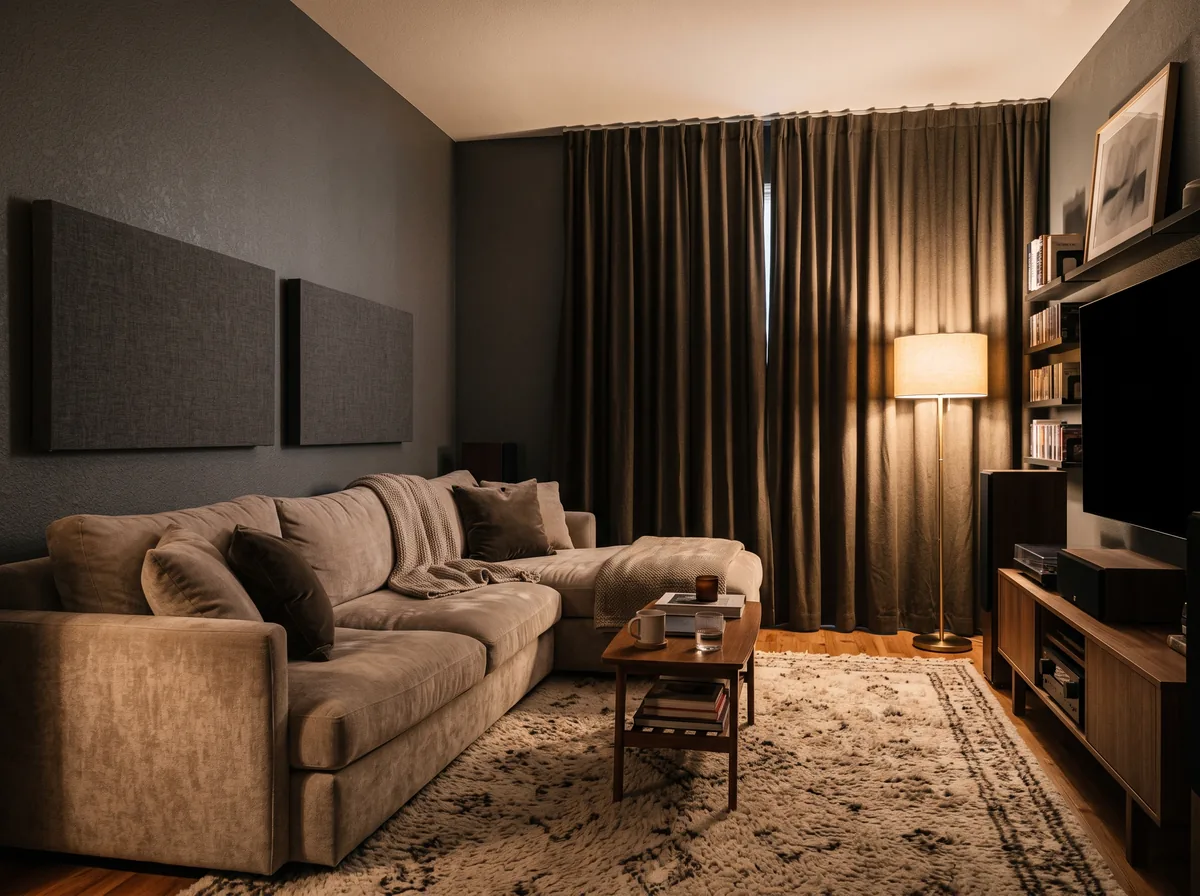
Hard, smooth, dense surfaces like glass, tile, and painted drywall reflect sound back into the room. Soft, porous, or fibrous materials like carpet, curtains, upholstered furniture, and purpose-made acoustic panels absorb it, converting the energy to a tiny amount of heat. A room full of hard surfaces bounces sound around and feels loud; a room with soft materials swallows those reflections and feels calm.
Reverberation and why empty rooms echo
That lingering ring after a sound stops is reverberation, and it is the single biggest reason a room feels harsh. An empty room with bare walls, floors, and ceilings has almost nothing to absorb sound, so it reverberates. Add a rug, a sofa, and some curtains and the same room instantly sounds softer. For the underlying physics, the science of how reverberation works is a clear read.
The one number worth knowing: NRC
Acoustic materials are rated with a Noise Reduction Coefficient, or NRC, from 0 to 1. An NRC of 0 reflects essentially all sound; an NRC of 1 absorbs essentially all of it. Purpose-built acoustic panels often sit around 0.7 to 0.95. Most decorative ceiling tiles, chosen for looks rather than absorption, sit far lower. The standard NRC rating explained is the number to look for on any product that claims a sound benefit.
Did you know
A drop ceiling with acoustic mineral-fiber tiles is one of the most common real acoustic upgrades in offices, and even those tiles usually rate around 0.5 to 0.7 NRC. Decorative tiles that mimic tin or wood are usually chosen for style, so always check the actual NRC before assuming a panel will quiet a room.
So do decorative ceiling panels help?
A little, in the right situation. If you are covering a hard, flat drywall or plaster ceiling with a textured panel, you are adding surface relief and, depending on the material, a small amount of absorption. In a room that already has soft flooring and furniture, that small change can be enough to take the last bit of harshness off. In a bare, hard room, it will not be nearly enough on its own. Here is a realistic look at common ceiling materials.
| Ceiling material | Typical NRC (absorption) | Realistic acoustic effect |
|---|---|---|
| Bare painted drywall or plaster | About 0.05 | Reflects almost everything, feels echoey |
| Decorative PVC or tin-look tiles | Low, often under 0.2 | Mostly cosmetic, slight texture benefit |
| Dense decorative foam panels | Low to moderate, varies | Minor absorption, still a style choice |
| Acoustic mineral-fiber drop tiles | About 0.5 to 0.7 | Noticeable echo reduction |
| Purpose-built acoustic panels | About 0.7 to 0.95 | Strong, designed for sound control |
NRC figures above are typical ranges for illustration and vary widely by specific product, thickness, and how the material is mounted. Always check the manufacturer rating for the exact panel you are considering, and confirm it suits your space before buying for an acoustic purpose.
Spend where it counts
If quiet is the real goal, you get far more absorption per dollar from soft furnishings and rated acoustic panels than from swapping a ceiling. Choose a decorative ceiling for the look you love, then budget separately for the specific spots that actually control the room’s sound.
How to genuinely quiet a room
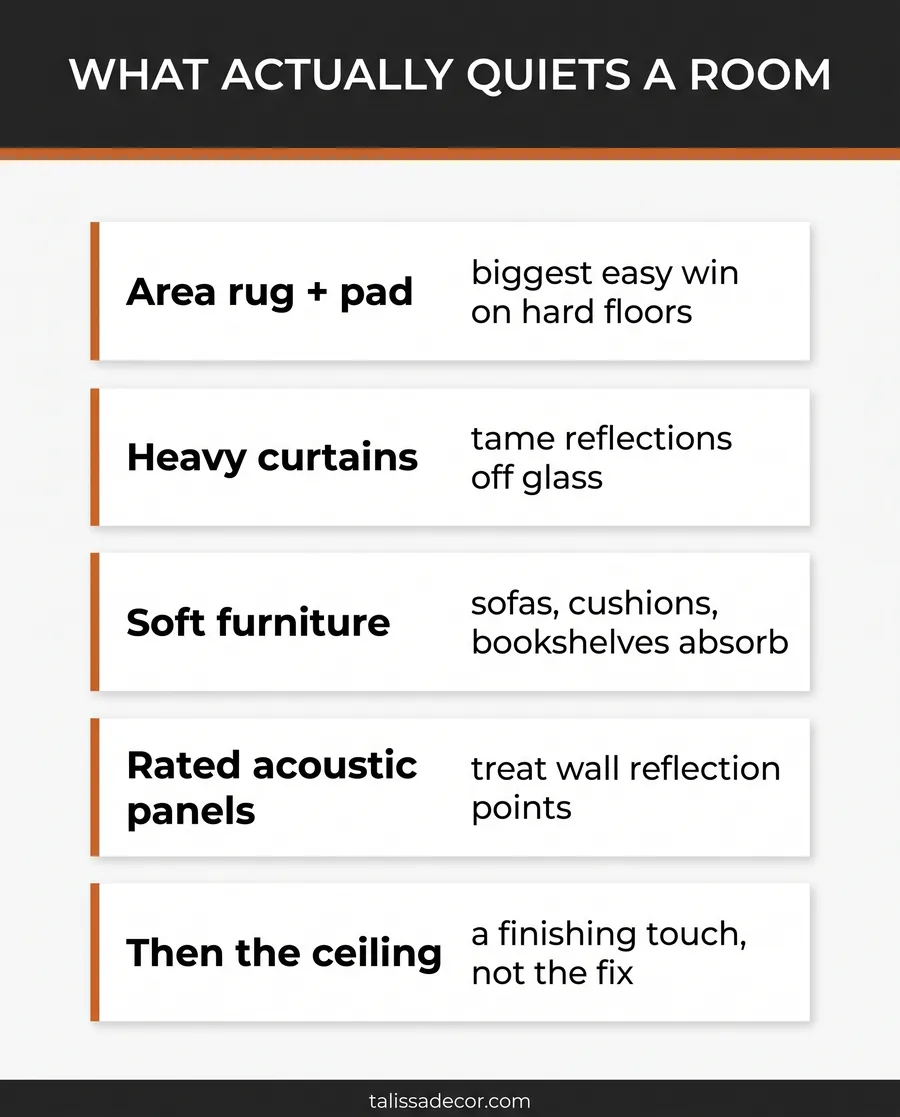
If a space rings, echoes, or feels fatiguing, the fix is to add absorption where sound reflects most, and to spread it across several surfaces rather than betting on one. A practical order of attack:
- Start with the floor. A large area rug with a pad is often the single most effective and affordable change in a hard-floored room.
- Soften the windows. Heavy curtains or drapes absorb sound and cut reflections off glass, one of the hardest surfaces in any room.
- Add soft furniture. Upholstered seating, cushions, and even a full bookshelf break up and absorb reflections.
- Treat the first reflection points. For a home office or media room, rated acoustic panels on the walls at ear level do the heavy lifting.
- Then consider the ceiling. Once the room is furnished, a textured or acoustic-rated ceiling can add the finishing touch, not carry the whole load.
Pro tip
Do the clap test. Stand in the middle of the empty area and clap once. If you hear a sharp ring or flutter after the clap, the room needs absorption. Add soft materials a surface at a time and clap again; you will hear the ring shorten as the room improves, which tells you what is actually working.
Where decorative ceiling panels fit in
None of this means skip the decorative ceiling. It means buy it for the right reason. A tin-look or wood-look ceiling transforms how a room looks, hides a dated popcorn or damaged surface, and installs quickly, and in a furnished room it can contribute a small, genuine acoustic improvement on top. That is a fair thing to want.
The mistake is buying a purely decorative panel expecting it to silence footsteps from upstairs or turn a bare basement into a quiet studio. If you want both beauty and better sound, pair a decorative ceiling with rated absorption elsewhere. Our guide to choosing the right tiles for your space can help you match the finish to the room.
Watch the marketing
Be skeptical of any decorative tile advertised as soundproofing without a published NRC or STC number. Soundproofing between rooms depends on mass and construction, not a thin decorative surface. If a claim sounds too good for a lightweight panel, ask for the rating before you buy.
Download the free quick guide
A one-page guide to what really controls room sound and where a decorative ceiling fits in.
Frequently Asked Questions
Want a ceiling that looks incredible and plays its part in a calmer room? Talissa Decor ships lightweight, easy-to-install decorative ceiling tiles and planks across the United States and Canada, from a condo in Chicago to a cafe in Vancouver to a home theater anywhere in between. Explore the decorative ceiling tile range to find your finish, or tell us about your room and we will help you choose.