 Largest Ceiling
 CALL :
 About us
 FAQs
 Gallery
 Contact



 Ceiling Planks
 2×2 PVC Ceiling Tiles
 Styrofoam Ceiling Tiles
 Wall Mural
 3D Wall Panels
 Crown Moldings
 Faux Wood Beams
 Other Products
Fire-Rated Ceiling Materials for Commercial Spaces
Every fire marshal who walks into a new restaurant, salon, or office lobby asks the same unglamorous question before anyone talks about design: what exactly is on the walls and ceiling, and can you prove it. For a business owner comparing commercial fire-rated ceiling materials, that proof is a published test result, not a line on a spec sheet or something a salesperson says out loud. Talissa Decor's own commercial ceiling tile collection exists because owners keep asking that exact question before they order anything.
The test behind that proof is more mechanical than most people expect. In the United States, ASTM's E84 surface burning test measures how far flame travels across a sample and how much smoke it produces inside a standardized tunnel, producing two separate numbers rather than a single pass or fail stamp. North of the border, the equivalent method, CAN/ULC-S102 surface burning testing through UL Solutions Canada, measures the same two things under a similar procedure. Neither test hands out a blanket verdict on its own; it produces numbers that a building department then weighs against the specific space.
Good to know
This article explains, in general terms, how flame-spread and smoke testing works for interior ceiling and wall materials and what Talissa Decor's own published test covers. It is not a determination that any specific product is acceptable for your building. Acceptability depends on your space's occupancy classification and the rules your local building department or fire prevention office applies, and those rules vary by location and change over time. Our own published surface-burning test result, detailed further below, covers one tested sample of one product pattern, not every finish Talissa Decor sells. Confirm the exact product, its documentation, and its acceptability for your project with your local authority and with our team before you install anything in a commercial space.
Why commercial fire-rated ceiling materials get tested this way
In practice, commercial fire-rated ceiling materials are compared against each other using the two numbers the tunnel test produces: how quickly flame spreads across the surface, and how much smoke the surface gives off while it burns. A low number on either scale is generally read as a better result than a high one, but the test itself does not translate that number into a legal answer for any particular building. That translation happens later, at the building department, not in the lab.
Talissa Decor's styrofoam ceiling tiles carry a fire-retardant surface coating, and the company publishes its own third-party result instead of only describing it in marketing language. The published test result for one sample, our RM24 tile pattern, recorded a flame spread index of 5 and a smoke developed index of 30, shown in full on our fire rating test results page. That number describes how that one sample behaved in one test; it is not a certification that every Talissa Decor product, pattern, or finish carries the same result, and it is not a stand-in for approval from anyone with authority over your specific space.

Who actually decides what's allowed in your space
A flame spread number and a smoke developed number are inputs, not a decision. Provincial and municipal building departments, along with the local fire prevention office, reference the same test standards when they look at what interior finishes a specific project can use, and that review takes the room's occupancy classification into account: a commercial kitchen, a packed restaurant dining room, a salon, and an open-plan office are not automatically treated the same way. None of this is something a ceiling tile supplier can settle from behind a counter, no matter how the product is described.
That is exactly why the honest answer to 'can I use this material in my restaurant' is almost always 'ask your local building department, and bring the test report with you,' not a flat yes or no from a blog post. It is also why owners furnishing very different commercial spaces, from a hotel lobby to a place of worship, still start with the same question rather than assuming their project is a special case.
Red flag
Treat it as a caution sign, not a green light, if a supplier tells you a ceiling or wall material simply cannot burn, or that any product automatically clears your local rules without anyone looking at your specific space. A real answer points you to a written test report and to your own building department, not to a verbal promise.
Did you know
The flame spread number and the smoke developed number are scored separately, and inspectors generally look at both. Two products can post a similar flame spread result while one produces noticeably more smoke than the other, which matters in a packed commercial room where visibility during an evacuation is its own safety question.
Seven checks before you specify materials for a commercial job
Here is a short, technician-style list for anyone specifying commercial fire-rated ceiling materials on a real project, in roughly the order it comes up:
- Ask for the actual published test report before you buy anything. A rating claim printed on a box, or repeated by a salesperson, is not a report.
- Confirm which test standard the report cites. A US-based ASTM method and the Canadian CAN/ULC method are not interchangeable paperwork, and a project near the border can end up needing both.
- Check that the report covers the exact product, pattern, and finish you are buying, since a published result for one sample does not automatically extend to every item in a manufacturer's lineup.
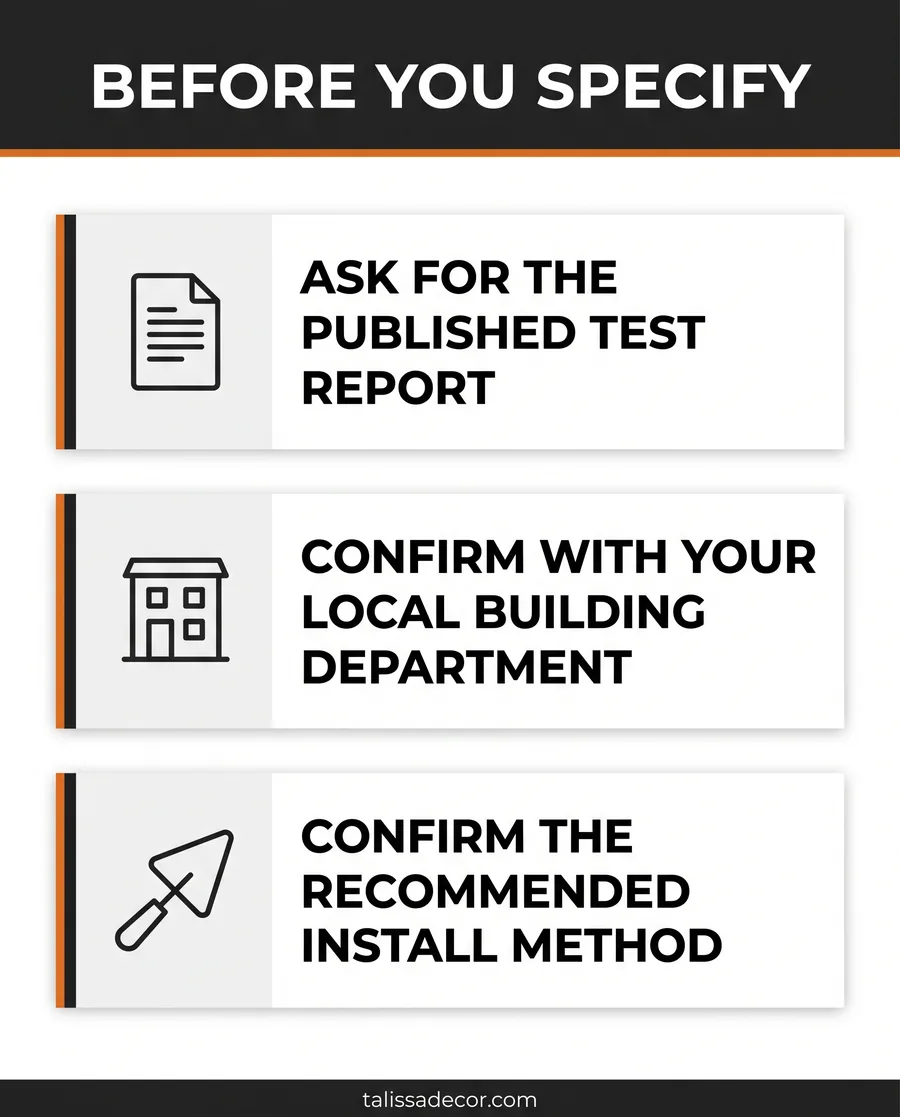
- Confirm acceptability for your specific space with your local building department or fire prevention office before you place an order, since occupancy type changes what they look for.
- Match the material to the specific area of the project instead of assuming one product suits an entire building; a dining room, a kitchen, and a back office are different questions.
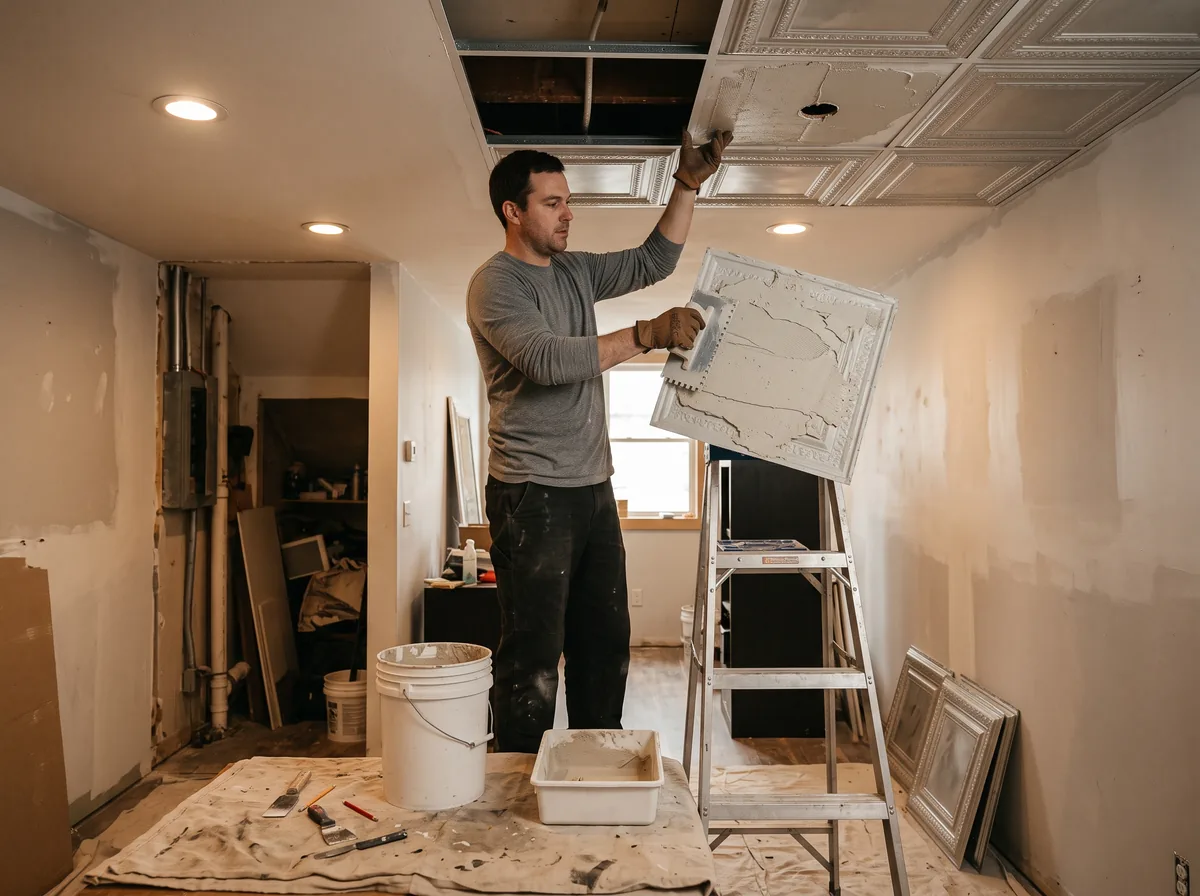
- Ask which adhesive or fastening system the manufacturer recommends for your substrate, and use the recommended tile adhesive or an equivalent the manufacturer names, rather than whatever happens to be on the shelf.
- Keep the paperwork on file where an inspector can see it, and treat a repaint, a different finish, or a renovation as a reason to check the documentation again instead of assuming nothing changed.
A look through our own office building installation examples shows the same pattern repeating across very different projects: the material choice comes after the questions above get answered, not before.
Download the free quick guide
A one-page checklist of what to ask a supplier and your local building department before you specify ceiling or wall materials for a business space.
Frequently asked questions
Does a fire rating mean a ceiling material cannot burn at all?
No. A fire rating describes how a specific sample performed in a standardized surface-burning test, measured as a flame spread number and a smoke developed number, not an absolute claim that the material is immune to fire. Treat any claim that goes further than the published numbers as something to verify, not something to take at face value.
Does Talissa Decor's published test result mean its tiles are approved for any commercial building?
No. The published result covers one tested sample of one product pattern, and it is a test result, not an approval. Whether a given product is acceptable for your specific project depends on your space's occupancy classification and the rules your local building department or fire prevention office applies, so that is the office to confirm with before you order material.
What is the difference between the flame spread number and the smoke developed number?
Both come from the same surface-burning test, but they measure different things: flame spread describes how quickly fire travels across the surface of the material, and smoke developed describes how much smoke the surface produces while it burns. A supplier or inspector generally wants to see both numbers together, never the more favorable one on its own.
The verdict on commercial fire-rated ceiling materials is simple even when the paperwork is not: a fire rating is a published test result on a specific sample, not a blanket permission slip for every room in a building. Ask for the report, confirm which standard it was tested against, and bring both to your local building department before you commit to a product.
If you are specifying ceiling or wall materials for a restaurant, salon, office, or another commercial space, ask the Talissa Decor team for the current documentation on the product you are considering before you place an order.