 Largest Ceiling
  CALL :
  About us
 FAQs
FAQs Gallery
 Contact


 Ceiling Planks
 2×2 PVC Ceiling Tiles
 Styrofoam Ceiling Tiles
 Wall Mural
 3D Wall Panels
 Crown Moldings
 Faux Wood Beams
 Other Products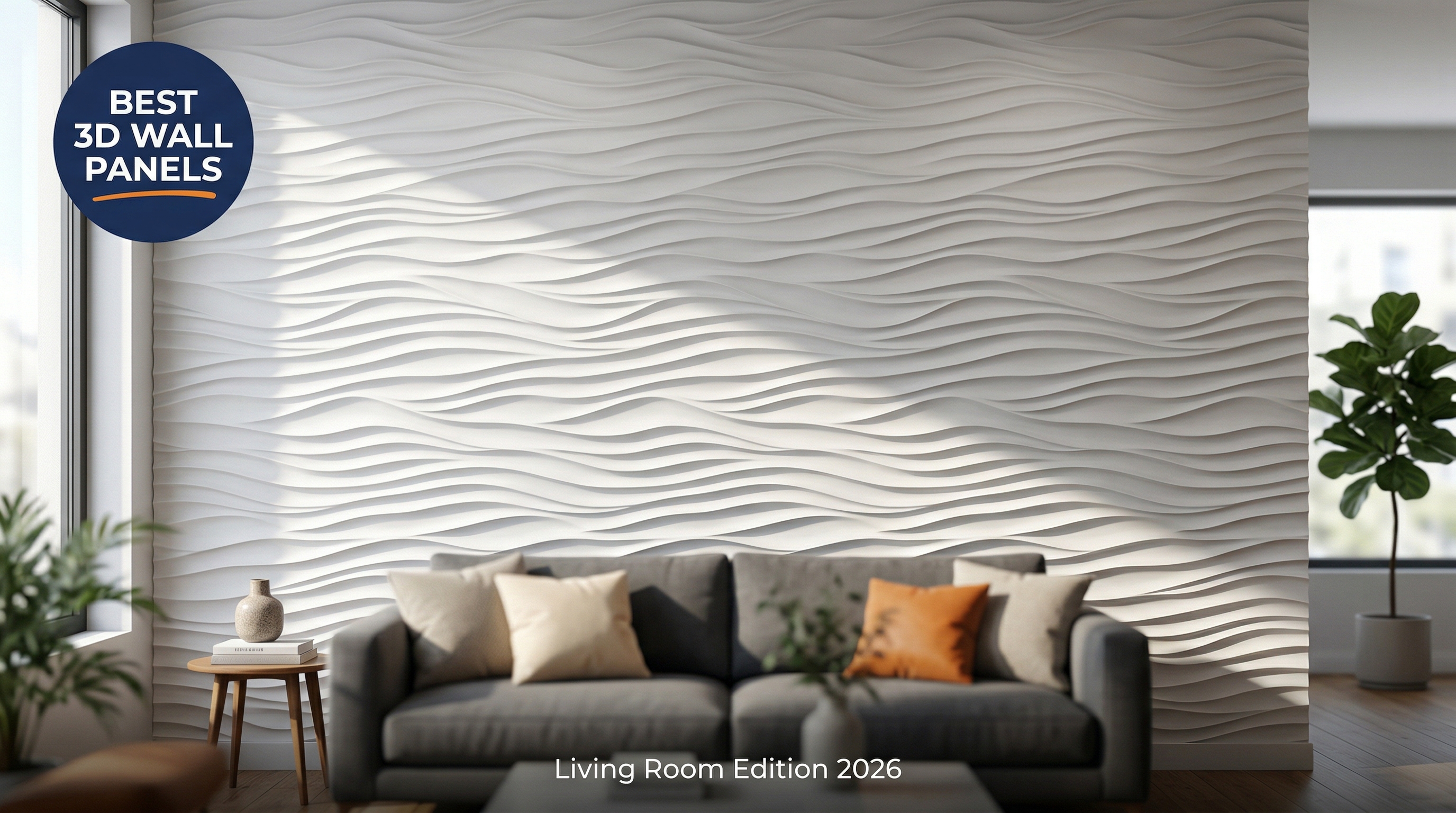
Best 3D Wall Panels for Living Rooms in 2026 (Materials, Costs, Picks)
3D wall panels turned into one of the fastest growing categories in interior decor over the past three years. They went from a niche commercial finish to a mainstream living room accent wall feature, and the reason is simple: a single panel covers a lot of wall fast, the texture catches light beautifully, and the install is forgiving enough that any homeowner can handle it. The hard part is picking the right panels for your room. There are now dozens of materials and patterns and the prices range from a few dollars per square foot to over twenty.
The best 3D wall panels for living rooms in 2026 are made from PVC (budget-friendly and waterproof), MDF (best overall for painting and a seamless look), plant fiber (eco-friendly and matte), and gypsum (premium architectural finish). Choosing the right material depends on your budget, desired pattern, and DIY installation comfort level.
This is our 2026 buyer guide for the best 3D wall panels for living rooms specifically, with the trade offs we walk customers through every day.
On this page
The four main materials
The first decision is material because it controls cost, install method, and long term durability.
PVC
PVC panels are vacuum formed from polyvinyl chloride sheet. They are waterproof, light, and cheap, which is why they dominate the budget end of the market. PVC is the right pick if you want to test the look without committing a fortune, or if your accent wall is in a humid space (rare for a living room but worth knowing). The downside is that the surface reads as plastic up close and the deeper relief patterns can look slightly cheap under harsh direct light.
MDF
Medium density fiberboard panels feel like wood, take paint beautifully, and offer the most consistent surface finish at a mid range price. MDF is the most popular pick for living room accent walls in 2026 because it strikes the right balance: it looks expensive painted, it cuts cleanly, and it costs about half what plant fiber or gypsum does. The trade off is weight (more than PVC) and water sensitivity (do not install in a basement that ever floods).
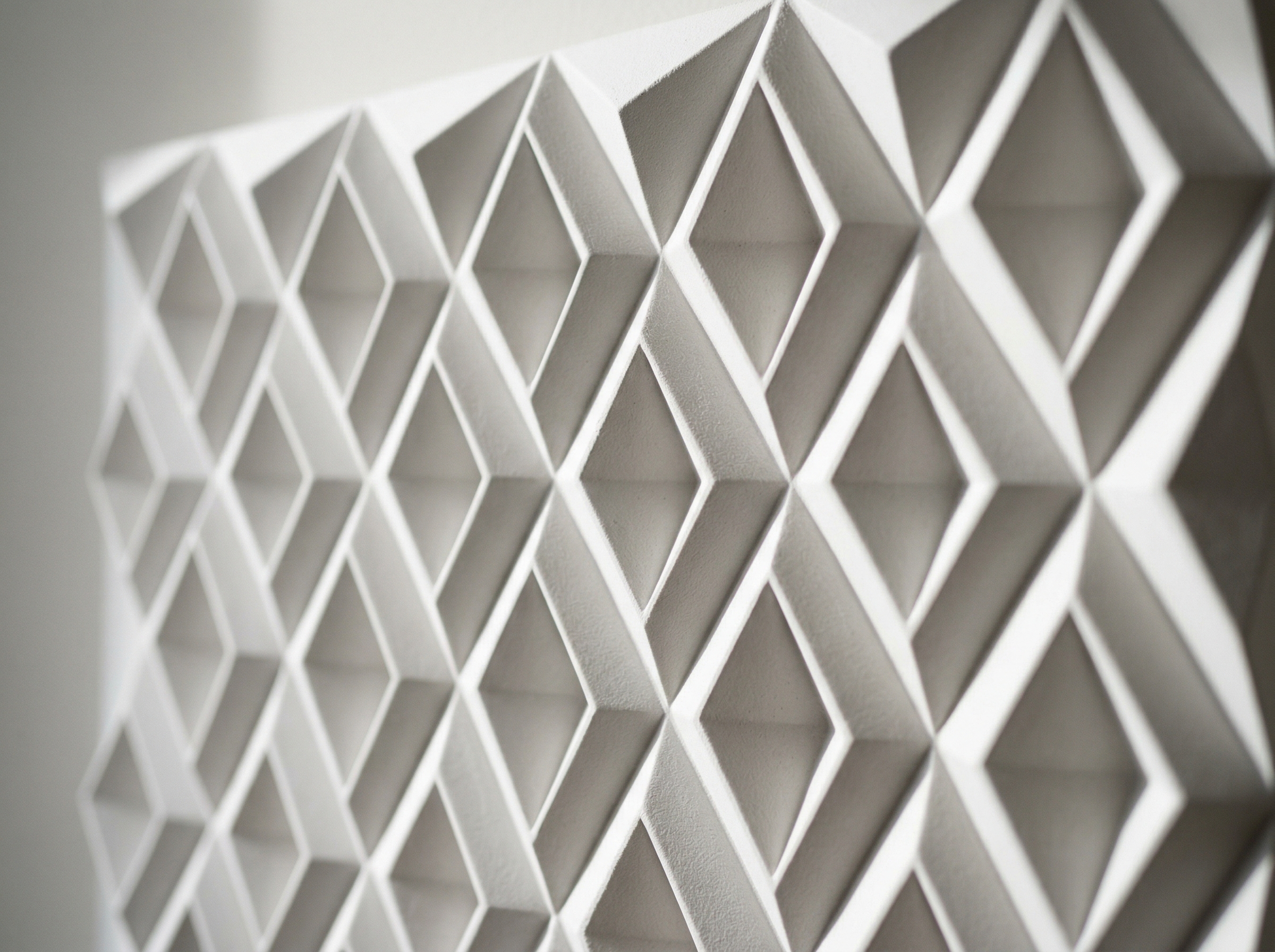
Plant fiber (bagasse, bamboo, sugarcane)
Plant fiber panels are made from agricultural waste products pressed and molded into 3D forms. They are eco friendly, surprisingly sturdy, and they have a warm matte finish that looks excellent painted or left natural. They cost more than PVC or MDF but less than gypsum. The market for plant fiber panels grew quickly because of the sustainability angle, and the quality has improved a lot since the early versions a few years ago.
Gypsum
Gypsum (plaster of paris) panels are the premium tier. They feel substantial, hold the deepest and crispest relief, and have a matte chalky finish that looks closest to traditional carved plaster. They are heavier than the other options, more fragile during transport and install, and more expensive. Gypsum is the right pick when you want a feature wall that reads as an architectural element rather than wallpaper.
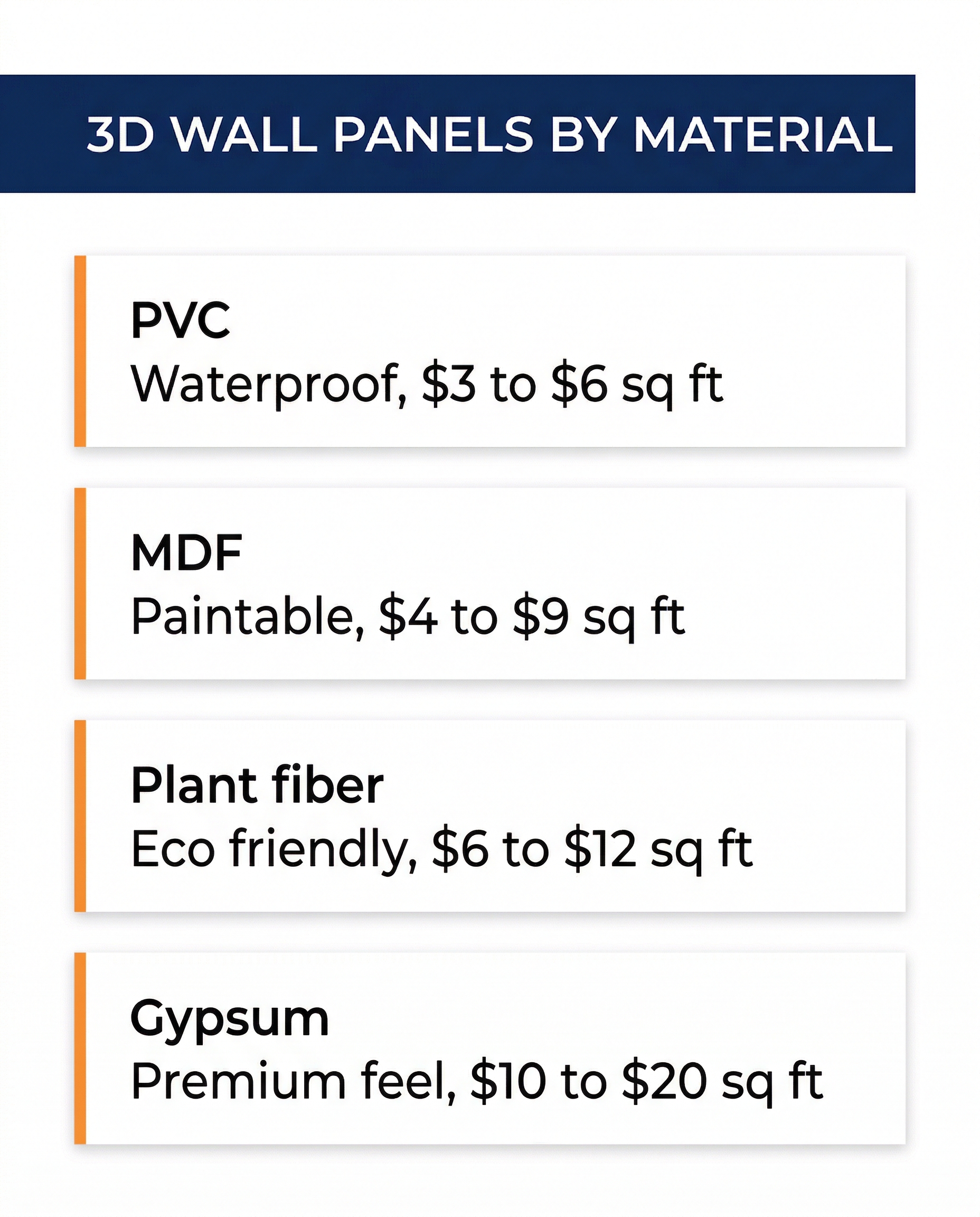
Costs in 2026
Here is what you can expect to pay in 2026 for residential quality 3D wall panels at U.S. online warehouses.
Picking a pattern for a living room
Living rooms are the most forgiving room for 3D panels because the wall is usually viewed from a distance (sofa to wall is rarely under eight feet). This lets you go bolder with the pattern than you would in a hallway or small bedroom. Three pattern families work well in living rooms specifically:
- Organic flowing patterns like waves, water ripples, dunes, and abstract topography. These soften a room and look best in rooms with rounded furniture and warm lighting.
- Geometric patterns like diamonds, hexagons, pyramids, and cubes. These work well in modern minimal rooms with sharp lines and contrast wall colors.
- Architectural patterns like coffered grids, deep relief lattices, and traditional Venetian plaster effects. These suit formal living rooms, traditional homes, and any space where you want the wall to read as built in rather than applied.
Avoid very busy patterns in small living rooms. The general rule is that a 3D panel is itself loud enough that you do not want to compete with it elsewhere in the room. One feature wall, plain ceiling, simple furniture, and you let the panel do the work.
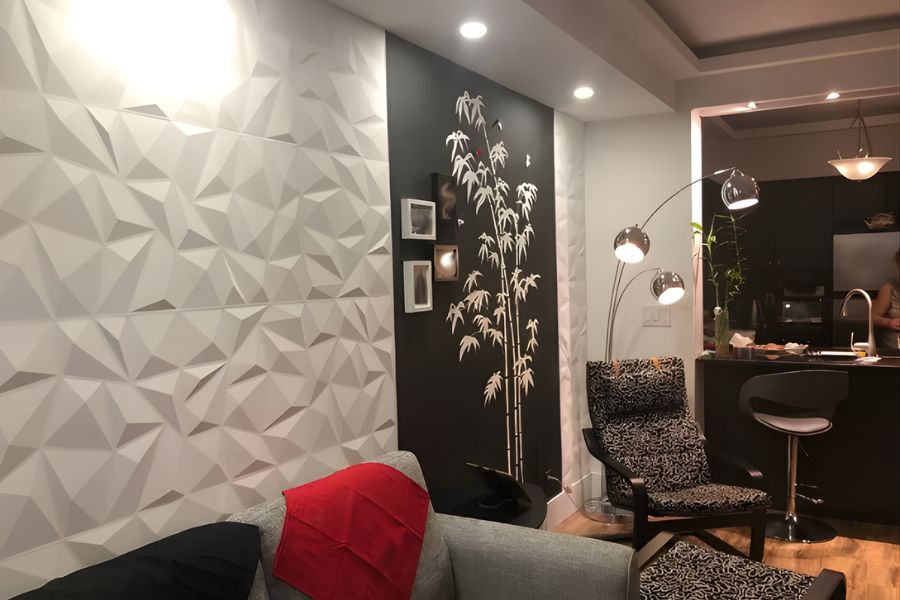
Install considerations
3D wall panels install easier than glue up ceiling tiles because you are working at a comfortable height and you can see your work clearly. Most panels go up with construction adhesive on a flat dry wall.
- Prep the wall. The wall must be dry, dust free, and reasonably flat. Fill any holes, sand any high spots, and let any new patches dry fully before you tile.
- Plan your layout from the center. Mark the horizontal and vertical center of the wall and dry fit a few panels to see how the perimeter will land. As with ceiling tiles, you want full panels at the most visible edge and cut panels along the least visible edge (usually the floor or where furniture covers the bottom).
- Apply adhesive in a perimeter bead around the back of the panel and a small X across the center. Avoid the edges that will meet the next panel (squeeze out is hard to clean off textured surfaces).
- Press and hold for 30 seconds, longer for heavier gypsum panels.
- Cut perimeter panels with a fine tooth saw, jigsaw, or sharp utility knife depending on material. Always cut from the back side so any small chips happen on the unseen face.
- Caulk seams and edges with paintable white caulk. The caulk hides any small gap and unifies the wall. This step is what separates a professional looking install from a kit looking one.
- Paint after install if you want a custom color. Use a foam mini roller for the flat areas and a small brush for the relief details. Two thin coats look better than one thick coat.
Our top picks for 2026
- Best overall: A mid relief MDF wave panel in a 19.7 by 19.7 inch format, painted a warm white. Looks expensive, installs easily, costs about five dollars per square foot.
- Best budget: PVC diamond pattern panel at around three to four dollars per square foot. Avoid the deepest relief versions because they look the most plastic.
- Best eco friendly: A plant fiber pyramid or hexagon panel in natural cream. These have an earthy matte finish that pairs well with neutral and bohemian living rooms.
- Best high end: A gypsum coffered or geometric panel installed across a full focal wall. This is the look that most often gets mistaken for a custom architectural feature.
- Best for renters: Lightweight peel and stick foam panels. They are not as crisp as the rigid options but they go up and come down without damaging the wall, which is the only thing that matters in a rental.
Common mistakes
- Choosing pattern before material. Pattern matters but material matters more. A great pattern in a poor material always looks worse than a simpler pattern in a quality material.
- Skipping the caulk. Visible seams between panels are the single most obvious sign of a DIY install. Always caulk.
- Painting before install. Paint after install so you can touch up the caulk lines, the cut edges, and any marks from handling all in one pass.
- Going too small on a large wall. A single panel in the middle of a big blank wall looks like an afterthought. Either fill the entire wall or set a clear boundary (floor to ceiling, wall to wall) so the panel reads as intentional.
- Lighting it wrong. 3D panels look their best with raking light from the side (a wall sconce, a floor lamp, a window). Flat overhead lighting kills the relief. Plan your lighting and your panels together.
What homeowners are saying
“Did our living room accent wall in MDF wave panels last spring. Took a Saturday and looks incredible at night with the floor lamp uplighting the wall. Best $200 we have ever spent on the room.”
r/HomeImprovement homeowner, 2024
Save this guide as a one page PDF and keep it handy while you shop or plan your install.
Frequently asked questions
Can I install 3D wall panels over wallpaper?
Only if the wallpaper is firmly bonded everywhere. Test by lightly tugging at a corner and edge. If anything lifts at all, remove the wallpaper first. The construction adhesive bonds the panel to the wallpaper, not the wall, so any wallpaper failure becomes a panel failure.
How do I clean 3D wall panels once they are installed?
Dust them with a soft microfiber cloth or a vacuum brush attachment. PVC tolerates wiping with a damp cloth and mild soap. MDF, plant fiber, and gypsum should be kept dry; spot clean only with a barely damp cloth and never use household cleaners that can stain or swell the surface.
Are 3D wall panels safe in a living room with a fireplace?
Keep flammable panels (PVC, MDF, plant fiber) at least three feet from a wood burning or gas fireplace. Gypsum panels are non combustible and can be installed closer, but always check the clearance requirements in your local building code or consult the fireplace manufacturer’s specification sheet. The U.S. Environmental Protection Agency publishes guidance on indoor combustion appliance clearances.
Do I need to worry about the panels off gassing?
Quality residential panels from reputable suppliers meet U.S. emissions standards (CARB Phase 2 for MDF, low VOC adhesives, etc.). Always ask your supplier for the spec sheet if anyone in your home has chemical sensitivities. Plant fiber and gypsum panels are the lowest emission options for sensitive households.
Can I install panels myself or do I need a contractor?
This is one of the few projects where DIY genuinely works and the result is indistinguishable from a professional install. The panels are large enough to cover ground fast, the adhesive is forgiving, and the only specialist tool is a jigsaw or fine tooth saw for the cuts. Budget half a day for a typical accent wall and you will have a great result.