 Largest Ceiling
  CALL :
  About us
 FAQs
FAQs Gallery
 Contact


 Ceiling Planks
 2×2 PVC Ceiling Tiles
 Styrofoam Ceiling Tiles
 Wall Mural
 3D Wall Panels
 Crown Moldings
 Faux Wood Beams
 Other Products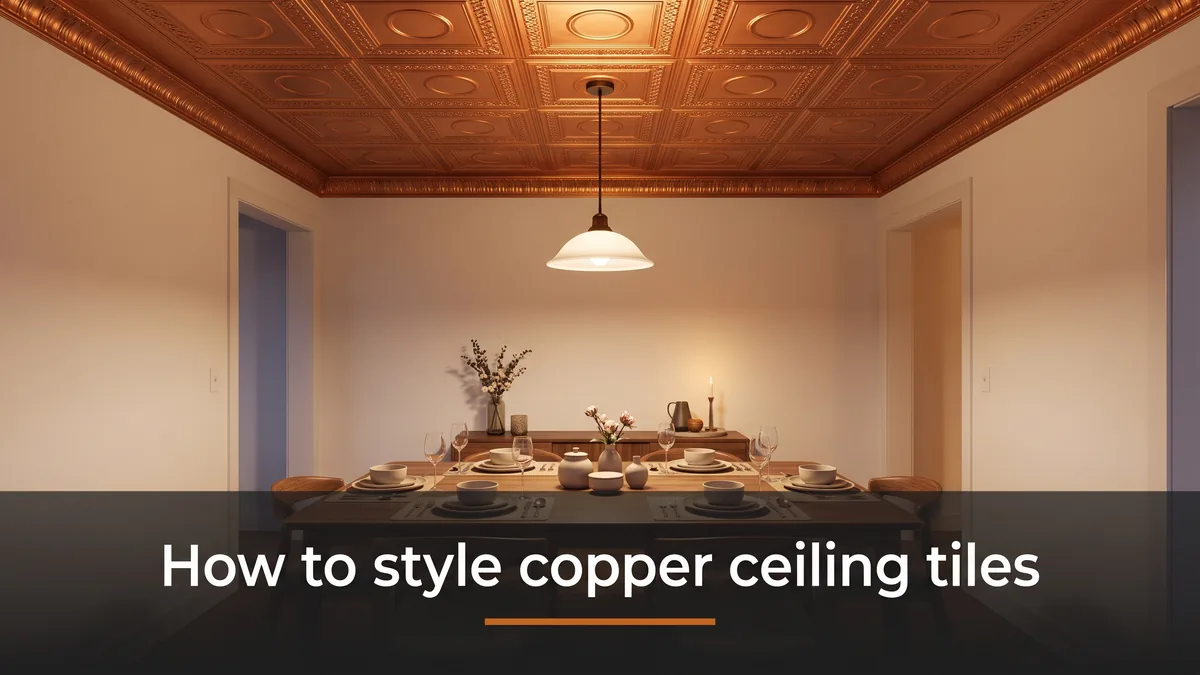
How to Style Copper Ceiling Tiles in Kitchens and Dining Rooms
Copper ceiling tiles work best in a kitchen or dining room when you treat the finish as a warm metallic accent, not a mirror. Keep the walls quiet, let the copper catch your lighting, and echo the tone in one or two smaller details so the room reads as designed rather than decorated. You can browse the warm copper and weathered finishes in our faux tin ceiling tile collection, but before you order, it helps to know how copper actually behaves overhead.
The short version: copper flatters warm woods, matte black hardware, and soft, layered light. It fights cool grays and harsh downlights. Below is how to pair it, where to stop, and how to make a small kitchen or a formal dining room feel finished instead of busy.
In this article
Why copper reads so well overhead
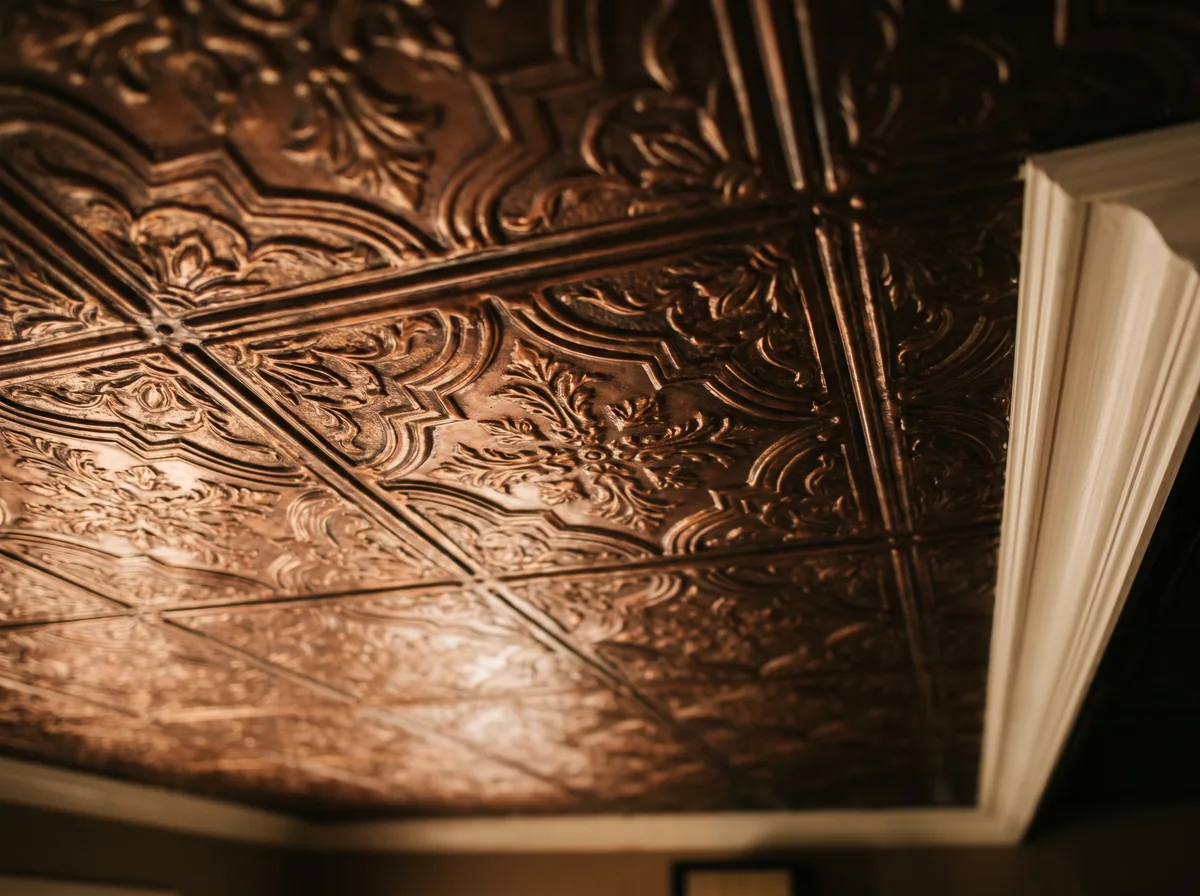
A ceiling is the one surface in a room nobody has to walk on, touch, or wipe down, which makes it the safest place to take a design risk. Copper rewards that risk. The tone shifts through the day, picking up amber at breakfast and a deeper rust glow under evening lights, so the same ceiling never looks flat.
Copper is also forgiving. Real hammered metal patinas unevenly and dents, while faux tin tiles in a copper finish give you the same warmth and relief pattern without the weight, the cost, or the green oxidation. If you want the metallurgy behind that warm color and its natural patina, the Britannica overview of copper is a quick, credible read. For the ceiling itself, the practical point is simple: copper adds heat to a room, so it belongs where you already want warmth.
Quick take
Copper is a warm accent finish. Use it overhead where you want a room to feel cozy and layered, kitchens and dining rooms especially, and keep the surrounding walls and trim calm so the ceiling gets to be the star.
Styling copper ceiling tiles in the kitchen
Kitchens are busy visually. You already have cabinet fronts, a backsplash, appliances, and open shelving competing for attention, so a copper ceiling has to be handled as the top layer, not another pattern in the pile. The trick is to give it breathing room.
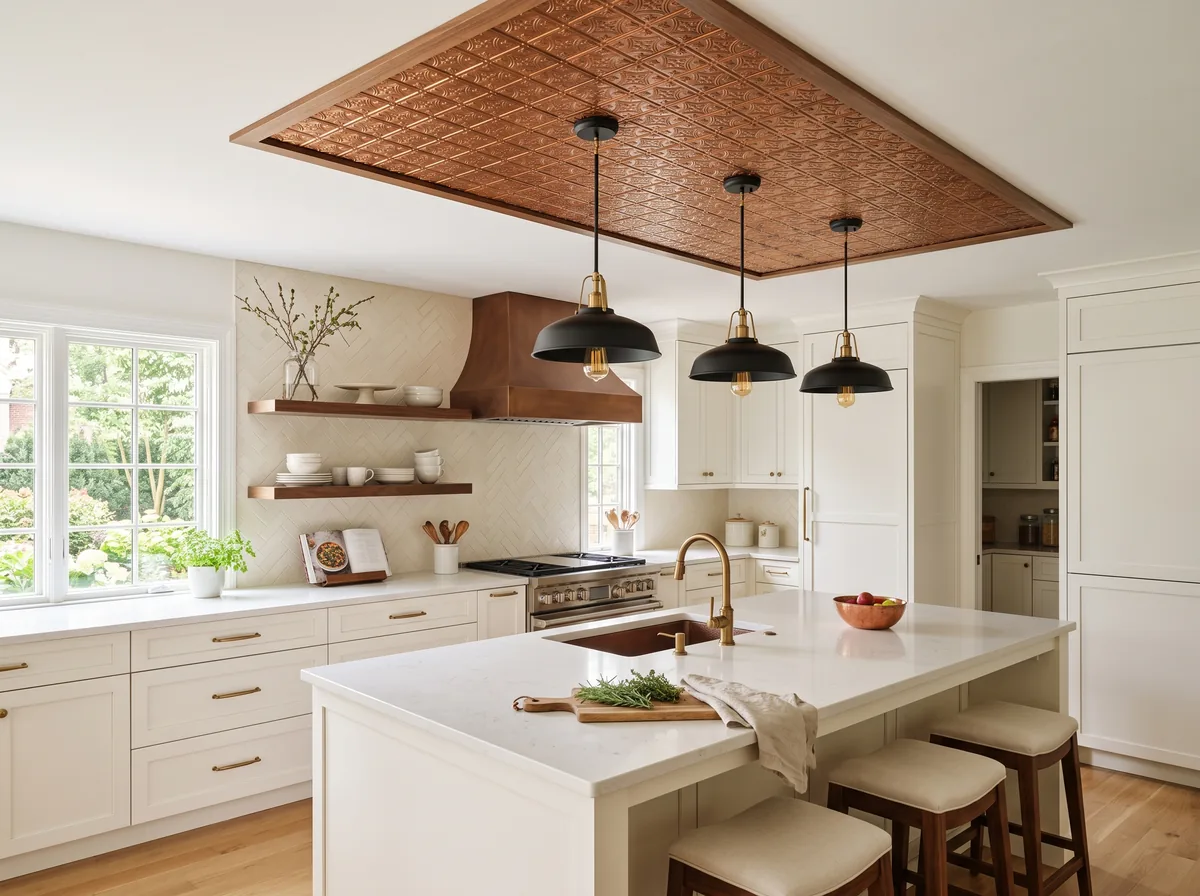
In a white or cream kitchen, a copper ceiling is an easy win. The warmth stops all that white from feeling clinical. In a wood-heavy kitchen, pull the copper toward the darker weathered end so it separates from the cabinetry instead of blending into a single brown haze. If your kitchen opens onto a living space, run the copper only over the island so it defines the room without swallowing the sightline. A tin ceiling and a matching metal backsplash panel can rhyme, but let one lead.
Pro tip
If your kitchen is small, skip a full copper ceiling and frame a single panel of tiles over the island or breakfast nook instead. A contained copper feature reads as intentional in a compact space, while wall-to-wall metal can close a small room in.
A dining room ceiling that sets the mood
Dining rooms are made for this. People sit, they look up between courses, and the light is usually low and warm, which is exactly the condition copper loves. A copper ceiling over a dining table does quietly what a bold wall color does loudly: it wraps the table in atmosphere without shouting.
For a formal room, pair a copper ceiling with deep tones underneath, a walnut table, forest or oxblood walls, and let a single statement fixture hang in the center. For a lighter, more modern dining space, keep the walls off-white and let the copper be the only warm move in the room. Either way, a copper ceiling pairs beautifully with crown molding, which frames the metal like a picture. Talissa's crown molding options in a matching finish make the edge feel built in rather than bolted on.
Did you know
A darker ceiling can make a tall dining room feel more intimate. Copper does this without the heaviness of a flat dark paint, because the metallic finish still bounces light back down instead of absorbing it. You get the cozy, lower-ceiling feeling and keep the room from going cave-like.
Pairing copper with cabinetry, counters, and metals
Most copper ceiling mistakes are really pairing mistakes. The metal itself almost always looks good. What goes wrong is the company it keeps. Use this as a starting point for what sits comfortably under a copper ceiling and what tends to clash.
| Element in the room | Pairs well with copper | Handle with care |
|---|---|---|
| Cabinetry | Cream, sage, navy, warm walnut | Cool gray, stark high-gloss white |
| Countertops | Butcher block, warm quartz, soapstone | Blue-veined cool marble |
| Metal hardware | Matte black, aged brass, bronze | Chrome and polished nickel |
| Wall color | Off-white, warm terracotta, deep green | Icy blue, cool millennial gray |
| Flooring | Warm oak, terracotta tile, wide plank | Gray-wash laminate |
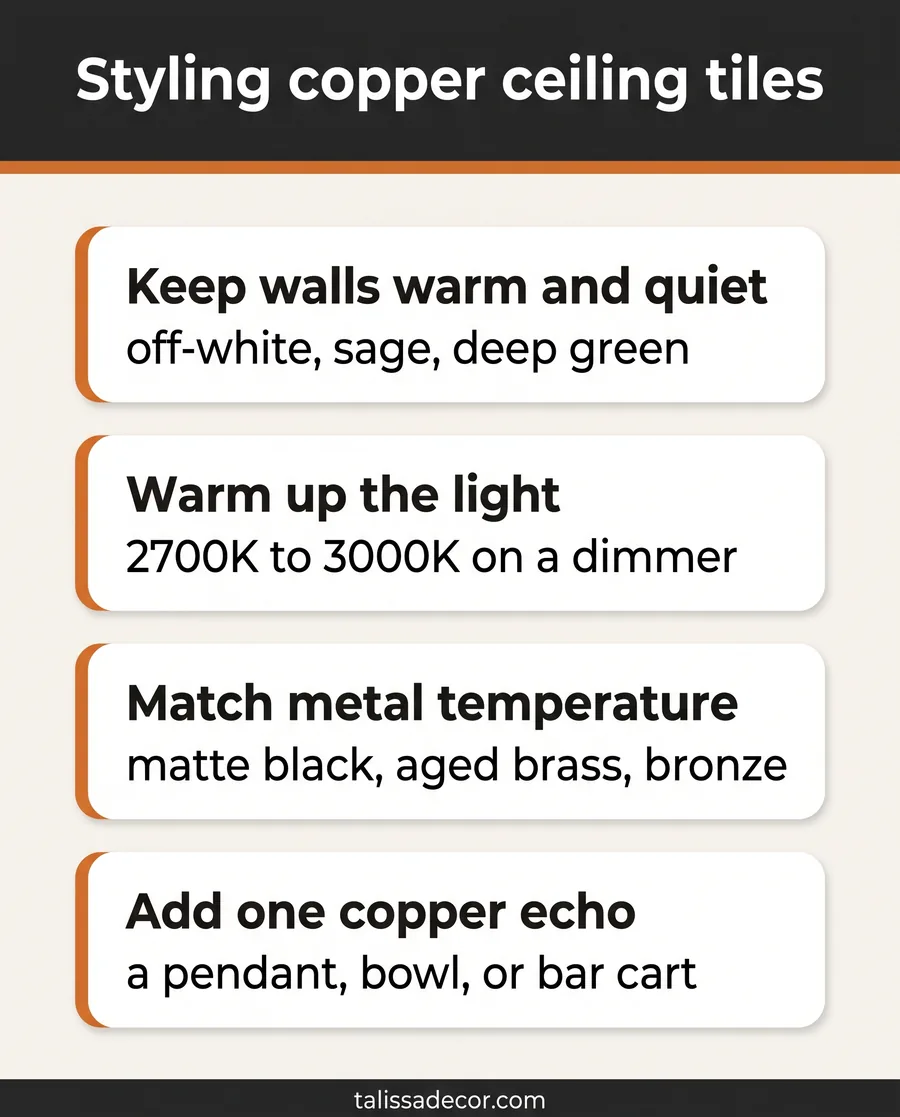
You do not have to match metals perfectly. A copper ceiling with matte black pendants and aged brass cabinet pulls looks collected, not mismatched. The rule that actually matters is temperature: keep your metals and undertones warm, and the room holds together.
Save your money
Order a sample tile before you commit to a full ceiling. Copper finishes photograph warmer or cooler than they look in a room, and a single sample held up against your cabinets and counters under your own lighting tells you more than any screen ever will. It is a small spend that prevents an expensive wrong order.
Getting the lighting right
Copper is only as good as the light hitting it. Flat, cool, overly bright light drains the finish and makes it look like painted plastic. Warm, layered, slightly directional light brings the relief pattern and the metallic depth to life.
- Choose warm bulbs. Aim for 2700K to 3000K. Anything cooler turns copper flat and gray.
- Layer your sources. Combine a central fixture with under-cabinet or wall light so the ceiling gets grazed from more than one angle.
- Avoid a grid of harsh downlights aimed straight up. Direct glare flattens the pattern. Softer, angled light reveals it.
- Use a dimmer. Copper looks its best in the evening when you can drop the level and let the finish glow.
Pro tip
If you already have recessed cans, swap in warm, wide-beam trims before you decide the ceiling looks wrong. Nine times out of ten it is the bulbs, not the tiles. A 30 dollar bulb change can transform how a copper ceiling reads at night.
How to bring copper into your space
This is general styling and planning guidance only. Product suitability, surface prep, and installation vary by ceiling and by product line. Always follow the manufacturer instructions for your specific tiles and confirm the finish and method suit your space before you buy or install. Talissa Decor is not responsible for outcomes from decisions made based on this article.
- Set the mood first. Decide whether you want the room cozy and formal or light and modern. That choice drives how dark a copper finish you pick.
- Sample against your fixed elements. Hold a copper tile next to your cabinets, counter, and floor, in your own light, before ordering the room.
- Pick your coverage. Full ceiling for drama, a framed island or dining feature for a lighter touch, or a backsplash echo to tie rooms together.
- Warm up the light. Move to 2700K to 3000K bulbs on a dimmer so the finish reads as metal, not plastic.
- Add one echo, not five. Repeat the copper tone in a single detail, a pendant, a bowl, a bar cart, so the ceiling feels connected to the room.
- Frame the edges. Finish the perimeter with crown molding so the ceiling looks built in and the transition to the wall is clean.
Did you know
Lightweight faux tin and PVC tiles can often go up over an existing flat ceiling with a glue-up method, which is why a copper ceiling is a realistic weekend project rather than a full renovation. Confirm the right method for your surface in the product installation guide before you start.
"Did a copper tin ceiling over our kitchen island last winter. Everyone assumes it cost a fortune. It completely changed how warm the whole room feels at night."
r/HomeImprovement homeowner, 2024
Download the free quick guide
A one-page reference for pairing, lighting, and placing a copper ceiling in your kitchen or dining room.
Frequently Asked Questions
Thinking about a warm copper ceiling for your kitchen or dining room? Talissa Decor ships lightweight decorative ceiling tiles and matching trim across the United States and Canada, with local pickup and fast delivery for shoppers in Montreal, Ottawa, and cities across North America. Get in touch with our team or order a sample and see how copper looks under your own lights before you commit to the whole room.